
I heard the story many times about how my father was once stricken with a psoriasis flare-up over 90% of his body. This was Job-level suffering, a red, angry, excruciating rash over almost every inch of skin.
Doctors photographed him for the record books. My mother described how all he could do was lay across the bed and weep in misery.
Eventually, a wise old physician made an intuitive leap and identified a strep infection as the cause. With antibiotics, my father’s condition improved, but he went through pure hell.
After hearing this story one more time, I finally asked when this happened. I had to reach a certain age and become a parent myself before my father’s adult life wasn’t just an abstraction. All of his stories took place in the same cloud of the past. The psoriasis flare-up could’ve happened thirty years earlier or fifty for all I knew.
Turns out it happened right after I was born.
I’m not being totally unscientific to see a cause-and-effect relationship here. Stress triggers psoriasis flare-ups.
Beyond just adding another mouth to feed, my birth gave my father a specific shock. A trauma. I was supposed to be a girl.
My mother was determined to have a girl. She’d already had my two brothers. In 1965, of course, you still had to wait for the baby to come out to know what you had, but, in a consummate act of wishful thinking, they took pink blankets and a little dress to the hospital for the girl my mother, without evidence, was sure I would be.
When I entered this world as a boy, my father took one look and realized that my mother would want to try again.
Just imagine!
My father is standing there in the maternity ward at Saint Domenic’s with a new baby in his arms. By just being a boy, I was guaranteeing him that they would do this all over again in a year or two.
Money was already tight. Most months my father was reminding the bank that he’d never missed a mortgage payment however late he had to make it. My mother was already overwhelmed taking care of my brothers.
But my parents made one more baby in hopes of getting the girl. And there I was.
If I had been a girl, it would at least mean they were done having kids. That would have offered my father some consolation. Some relief.
But the nurse brought him a swaddled bundle and said, “Here is a spare human you’ll have to feed, clothe and worry about while you go back to planning for another pregnancy, another shot at a girl.”
There’s no way to prove that I gave my father a burning rash over his whole body, but I’m sure of it. I don’t resent him for having this reaction, over which he surely had no control anyway, but I do take it as a measure of how much my mother wanted me to be a girl.
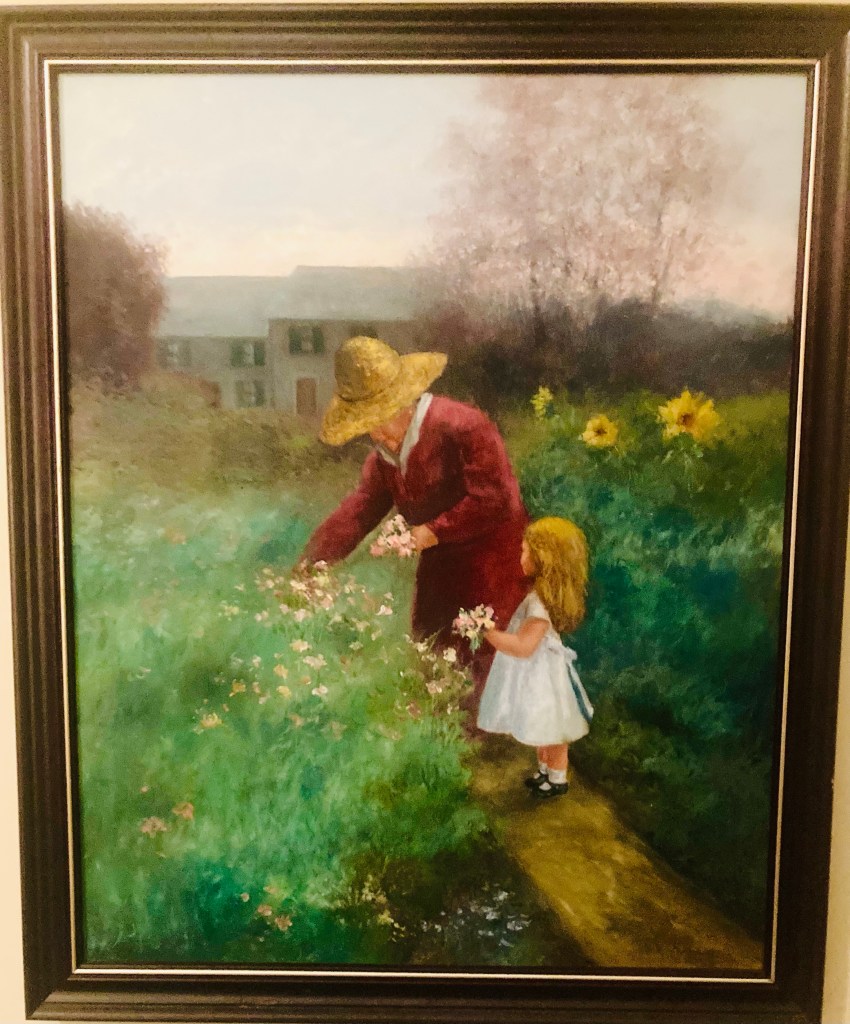
These reflections came back to me on the last night of my last visit to Mississippi for my father’s funeral. I felt a heavy melancholy as I lay on the bed in my sister’s guest bedroom looking at my mother’s painting on the wall across the room.
In an overgrown summer field, an older woman in a long-sleeved crimson frock and a straw hat picks flowers while next to her a little girl in a white dress and black Mary Janes holds her own bouquet.
They’ve discovered the flowers in an impressionist blur of tall grass. Wildflowers. Random, humble beauty. An opportunity to be seized.
You can’t look at the painting without hearing the chirring of cicadas.
The grandmother and child will take their clusters up to the slate-colored house with the bottle green shutters and sink them into small glass vases, one for the table at lunch and one for a window sill.
Picking flowers is serious work. The grandmother has a look of concentration. She’s building her arrangement as she picks, selecting each bloom according to the play of pink and white streaks. The girl is watching. Paying attention. Protecting her own arrangement, assembled with equal care.
As I contemplated the painting, I became aware that I wasn’t simply exercising my imagination to “appreciate” the subject matter the way you might look at an old battle painting and imagine what it would be like to stab someone with a sword with the hoof of Napoleon’s rearing horse at your ear. I had sense memories of making my own bouquets with my mother or grandmother. I remembered the soft stems under my fingers. remembered my relief as they sank in the water behind the veined glass of the little bottle. I remembered watching for the mysterious effect their beauty would have on everyone gathered around the table for lunch. I remembered how eventful the story of discovering and plucking the wild blossoms sounded.
It had never occurred to me the degree to which I had been treated as a girl.
The story of the pink blankets at the hospital was old news. I’d heard about it my whole life. I’d been mulling for a few years about how my failure to be born female could have triggered my father’s psoriasis flare-up. But I had never considered how my mother could not have simply put her desire for a daughter on ice.
Even if she’d been free to do so, she would never have gone as far as truly feminizing me by putting ribbons in my hair or making me paint her toenails, but there was a sensibility she was longing to pass on to a girl, a perspective on life captured in the painting.
I was too young to participate with my brothers in my father’s attempts to spark in them a passion for hunting and fishing. So, in a way, my mother had me all to herself. Maybe that’s all wanting a girl was about.
The first time I recall being aware that my mother had a “sensibility,” without of course knowing either the word or the concept, was when my brother Mark presented to her a little figure of a dead knight.
He had found a letter opened fashioned to look like a rapier with a tiny ruby on the pommel. He sculpted a figure of a man out of our gray modeling clay, stabbed him through the heart with the rapier and draped the corpse over a block from my dad’s shop.
Mark grew up to be a sculptor, and it’s strange to see in my memory of this little clay man his unique style, a high Modernist sense of pure form. The dead knight’s shape in my mind evokes Moore and Giacometti, with his elongated legs draped over the edge of the block, the face with only artful indentations for eyes and just the suggestion of a nose, yet all of it nevertheless expressing idealized death.
When he presented it to my mother, she exclaimed, “Oh my goodness, is that the hero?”
“Huh?” Mark answered in a very blunt “duh” tone. “No! It’s the bad guy!”
“But the hero has to die,” my mother sighed as if she had stepped out of a Tennessee Williams play.
Mark lingered long enough to ask “why?”
“It’s so sad but beautiful,” she answered. “The hero has to die.”
“No, it’s the bad guy,” Mark said then ran off.
I looked at the dead knight’s shape. The rapier was falling out of the clay, so we had to keep re-stabbing him to sustain the tableau.
I asked, “It’s the hero, Mama?”
“Yes, the hero always dies.”
I remember having a distinct feeling of learning an important secret. It’s far more beautiful for the hero to die. The understanding gave me a little ache.
This was certainly the product of having been the private audience of her romanticism since my first moment on the earthly plane.
There was a strong French element in this romanticism that I have yet to decrypt. 23andMe identifies a tributary of my blood flowing from the Alsace-Lorraine region of Europe, and the source of this stream was certainly not all of the Yorkshire descents on my father’s side. My uncle, my mother’s only surviving brother, explicitly referred to my great grandmother as French: “Well, of course, she was French.”
They were from Louisiana, so I guess he meant Cajun. But some of my genealogy research says she was maybe Huguenot.
Either way, one of my very earliest memories was a sense of being introduced to French culture. My mother read to me a picture book set in France with stylized illustrations of wrought iron balconies, men with curling mustaches, bicycles, baguettes, pipes with smoke squiggling up and a Siamese cat.
My dim memory of the illustrations are of ink outlines with artfully careless washes of color going outside the hair-fine boundaries. The pictures in my mind look French.
Of course, my main memory is feeling my mother’s arms around me and her voice in my ear. She was pointing at the page and laughing with genuine pleasure. The cat climbing the ivy-covered trellis with the look of mischief was funny. Funny to her. And delightful. So I learned from her what is funny and delightful.
I have no memory of the story but I think there was a whimsical man, maybe a baker. Yes, a baker sounds right. He was in an idealized French neighborhood and continually faced charmingly harmless difficulties with the aforementioned cat. My mother joked that the cat must be named Minnette because this was the name of our own Siamese cat with a hook at the end of her black tail.
The painting on the wall of my sister’s guest room looks to me like Proust’s Combray, although I’m absolutely certain that my mother never heard of him. But it’s easy to picture fat stalks of asparagus in a basket on the table in the house.
As I lay on the bed, sunk in grief for my father, looking at the painting, I suddenly realized that I was identifying with the little girl. I mean that I was seeing myself as her and specifically as a “her.” I wasn’t just connecting with the image of a child. I was that little girl in the dress, in the shoes, with the long hair and elegant posture. I was a girl.
I recently read a memoir by someone born male who decided in his mid-sixties to feed photos of himself into gender-switching app. He experienced such a profound sense of recognition when he saw himself as a woman that he transitioned to female. Some 30-odd people soon received an email that said, “your close friend Luc Sante is now Lucy.” (Her memoir is titled “I Heard Her Call My Name.”)
And wouldn’t it be a great literary payoff in this narrative you’re reading now if I told you that you should now think of me as Kendra rather than Kenneth?
However, my feelings looking at my mother’s painting didn’t trigger that particular dysphoria. Something way simpler was going on.
My mother died out of the blue 20 years ago. The phone on my desk at work in New York rang. My sister said my name then went silent. A new voice got on the phone: “This is Sister Something Something at Saint Domenic’s Hospital in Jackson. Are you sitting down?” I was sitting down and, of course, realized that I was about to hear devastating news.
Sister Something Something had obviously made this sort of call before. Her way of telling me that my mother was dead was very subtle and gentle: “Your mother was admitted to the emergency room last evening and, in spite of the doctors’ efforts, unfortunately, they were unable to revive her.
She took me on a little journey.
My mother was 69-years old. Recent hip replacement surgery was causing her a lot of discomfort, but I didn’t expect her to die. Now I expect everyone who goes to the hospital to die. But I didn’t expect anybody to die 20 years ago.
My mother had a sudden heart attack. My sister has speculated that my mother “popped a clot” from the hip surgery. But who knows?
The point is that her death was a massive shock. I was numb until I flew down to Mississippi. My brother had just put together a photo album with some full page prints of my mother. Minutes after I walked into the living room my father handed me the album. I opened the cover and came unraveled. Everyone in the room had done the same thing before I got there.
My copy of that album is in a drawer in my bedroom. 20 years later, I still can’t open it. In some technical sense, I’ve been unable to really grieve for my mother’s death, to accept that she is gone. She died too suddenly.
When you try to explain mourning someone’s death it sounds trite like a Hallmark card: it’s the process of accepting that the loved one is gone so that they can live in your memories. That’s how it has been with my father. He’s alive in my mind. I can hear his voice. I can talk about his life with my siblings as though he’s in the next room out of earshot, yet I’m fully aware that he’s left this world. My psyche has a firm grip on this paradox.
But this is not the case with my mother. I’m blocked. When I think of that photo album in the drawer, a panic seizes me. I just can’t go there. Which means I still can’t enjoy memories of my mother, at least not beyond a surface level of seeing past scenes like I’m floating up at the ceiling. I can’t relive the moment. I can see my mother holding out a spoon for me to try the stew in the kitchen, but I can’t taste it or meet her eyes as she waits for my reaction.
Or … I should say that I haven’t been able to do so.
However, at my father’s funeral last year, I was reading aloud from the podium the obituary I wrote for him. His death made us sad, of course, but his demise stretched out for years. So there was not much weeping and wailing. But when I got to the part of his story where the first sparks of romance flew between him and a young girl in his drawing class at art school, the tears hit me right there at the podium. I felt guilty about it. Everyone in the audience probably assumed that I was choked up over Dad, but, out of nowhere, my mother finally resurrected herself in my psyche.
I wasn’t crying because my father was dead but because I was remembering my mother. But it was more than memory. I saw her. A little ghost in my skull. I saw her glance up from her sketchbook in the afternoon light in that Memphis art studio with Nat King Cole singing “when I fall in love” from a nearby radio.
My theory is simply that my father’s death started to knock the wall down blocking me from mourning Mother’s passing. Dad basically died of old age. His funeral confronted me with the passage of time as a natural part of life. There was no shock. No outrage. We grow old. Our parents die.
As such, this gets me closer to accepting Mother’s death.
Seeing myself … recognizing myself … as the girl in the white dress and Mary Janes was another crack in the wall.
It didn’t and doesn’t unlock a need to transition into Kendra because I’m not remembering being a girl. I’m remembering being treated as my mother’s temporary daughter.
I’m not trying to take that little girl out of the painting. She is drawing me into it.
In that surreal feeling that the painting is turning me into that girl, my separation from the memory of my mother vanishes. Becoming that girl, I go back to the first years of my life when my mother had me all to herself and I had her all to myself.
It’s startling at 60 to consider that we’re now talking about a long time ago. Whenever I have to give my date of birth on some website, I feel like I’m in The Time Machine spinning that virtual wheel back to 1965. Buildings shrink as parking lots melt into grass. People speed walk backwards. Forests rise as backhoes and bulldozers back up.
As the date wheel slows down, a distant sun shines through the leaves of a tree that’s long gone. Big cars with fins glide past outside. My great grandmother, born in 1882, calls my grandmother from deep in the house, “Janey Belle! Janey Belle!” (but I thought she was shouting “Janey Bear.”). A music box plays a melody I later learned was “Strangers in the Night.”
My mother laughs in my ear.
Her gentle finger on the page of a book guides my eyes to a cat’s funny face.
A cardinal sings outside the open window.

