
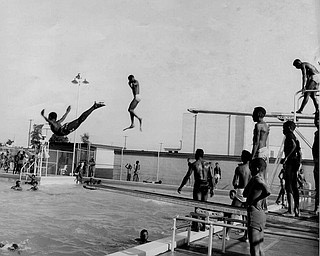
We all swam at the YMCA pool on Manhattan Road in my little neighborhood in Mississippi when we were kids. Just saying that conjures an entirely different world for me.
I remember riding my red bike to the pool. That means that I could have been as young as 6 or 7.
Over 50 years ago. The early 1970s. If I were a 60-year old man reminiscing back then, I’d be talking about the early 1920s.
And 50-plus years later it hits me that a 6- or 7-year old was just bolting out of the house and riding his bike a mile to a swimming pool.
“We’re going swimming!” I’d shout.
“See you later!” my mother would shout back from somewhere in the depths of the house, a faint breeze blowing from the backyard screen door. She didn’t rush to the door and harass me with instructions to be careful. She didn’t make me wait to coordinate the “playdate” with some other mother who was taking her children to the pool. She didn’t stand in the street and watch me ride off.
She loved me. She loved us. If she thought I faced any danger, she’d have laid down her life.
There’d be chicken-and-dumplings and a pitcher of tea waiting when I got home. A chocolate pie.
So this flash of myself pedaling down Keele Street by myself on my red bike comes from a world where my loving mother could let us ride our bikes all over creation.
I just ran out and pedaled off on my red bike.
Like nothing.
Down Keele Street to a busier street called Cedars of Lebanon. Then I cut over to Bounds Street where there was a dirt path through a small field of weeds. The path let out right by the pool.
These early memories are impressionistic. As if Marie Hull had spread paint on the walls of my skull with a palette knife. The pool is a smear of blue under a blinding sun straight above. A star of glare on a chrome ladder. Then my memory jumps to being in the water surrounded by a riot of screaming kids. The sharp aroma of excessive chlorine.
The low dive was no big deal. But I only tried the high dive a couple of times. I was a chubby kid, so I really slammed against the water from that height. It was too much of a shock.
Eventually, a pretty obvious question occurred to me: “Where were the black kids?”
There were always black people in any public place. Malls, restaurants, parks. But there were no black kids at the pool.
Somebody could have just told me: the pools are segregated. But no. The answer I got was “black people can’t swim.”
What? Black people can’t swim? Why not?
If you were raised in Jackson, Mississippi the same time I was, you know the answer.
Black people, as it was explained to me, have heavy bones. They can’t float. Black people aren’t buoyant.
I couldn’t get any further details, so a lot was left to my imagination.
Were black people just somewhat less buoyant or did they sink like stones?
I tried to imagine what it felt like, my skeleton pulling my flesh down to the gritty bottom of the pool.
This news made me sad for black people. What a bummer to not be able to go to the pool.
Adults gave me this explanation without a smirk. It was basic scientific information.
I remember on some TV show like Mannix or Mission Impossible, the services of an expert frogman were required. And here’s this black man in a scuba suit! And then we see him diving down among the fish. He doesn’t sink! On the contrary, he elegantly glides his way around a big reef looking for evidence. Then he fights another knife-brandishing frogman who swims out of the seaweed. And he wins! What the heck? I thought black people couldn’t swim!
Ah, my parents told me, it’s just HARD for black people to swim with those heavy bones. This black frogman had really trained and was very strong.
In these early years, I wasn’t exposed to black people enough to ever hear any contrary evidence about whether they could float.
I went to a school with no black people. There was no direct narrative for why this was so, like the heavy bones story for the pool. I guess there was no way to sustain some bogus pseudo-scientific theory to cover such a big part of life. I was in my 50s before I realized that I had been sent to a school created by The White Citizens’ Council. A genuine white supremacist school!
Money got tight and my parents sent me to McWillie, the public elementary school. The roughhousing on the playground among the black kids worried me. I was afraid of those heavy bones. One day, this black kid named Harvey charged at me with a big grin and rammed into me. Ow! I thought I was going to die. His bones DID seem harder!
He laughed and helped me up and we became pretty good friends that year. When my mother came to school on parents’ day, Harvey sat next to her at lunch. He kept asking her things. “Miz Nowell, Miz Nowell, do you like to bake pies? Chocolate pies?”
That night she said, “That Harvey is just as sweet and polite as can be!”
This is a complicated memory.
I was getting old enough to understand what adults really meant. “Harvey is just as sweet and polite as can be” would usually mean “I’m shocked to encounter a black child that is not a rude savage.”
But … no. That wasn’t it. Harvey WAS sweet. I saw that he instantly loved my mother. And she was sweet back to him. She was so charmed by his “Miz Nowell, Miz Nowell!”
I heard the feeling in her words. She wasn’t saying that Harvey was marginally civilized for a black kid. She loved Harvey. I knew she wanted to hug him.
“I’m gonna have to bake him a chocolate pie!”
But I knew damn well not to ask Harvey to come over to my house to play.
One day my family was driving in the Hanging Moss neighborhood on the other side of the tracks, and I saw another YMCA pool like ours. But … wow … every soul inside the chain link fence was black. And it wasn’t just a few very ambitious athletes who had built up their strength to overcome their inherent lack of buoyancy. The pool was mobbed. Thick with kids!
At first, I wondered whether they were all just playing next to the water. Why not? Just dancing and throwing the beach ball in proximity to the cool water.
But, no, I could see them taking running leaps into the water and splashing. Some kid was flying off the high dive.
By that age, if I had just stopped to think about the theory that black people couldn’t swim, I would’ve grasped that it was just a joke. But I had forgotten about the whole issue somewhere along the way without making a conscious correction, so in the back of my mind I still believed that black people literally couldn’t float.
So, with a full and enthusiastic voice, I urged everyone in the car to observe all of the black people enjoying the pool and clearly exhibiting the ability to swim. Except in simpler language.
To the great amusement of the everyone in the car.
But it was more than a joke.
My parents, especially my father, used euphemisms for almost anything awkward, complicated or otherwise socially charged.
I’ll hear my Brooklyn neighbors, who pride themselves on enlightened directness, tell little Timmy: “Go into the bathroom and expel urine out of your penis.” Well, I exaggerate. But my father would almost always call it shaking the dew off the lily pad.
I hate to think how long I tried to figure out what shaking dew off a lily pad had to do with peeing.
When I was on the threshold of puberty, my father sat me down and said: “Son, for the next few years, you’re going to feel reeeeal clumsy.”
“What? Why?”
“You’re just going to feel clumsy.”
“What do you mean?”
“You’re going to feel like your feet are too big. You’ll be tripping over your feet.”
That was it. The whole puberty chat. And from that day until this moment, I can honestly say that I have never felt that there were any proportional issues with my feet. Ever. My feet are just fine.
But very few moments have passed when I didn’t feel like my feet were too big.
My feet are the right size while being too big.
Along the same paradoxically lines, the implied message was “black people might be buoyant, but they can’t float.”
“Black people can’t swim” and countless other little myths and jokes were in effect just euphemisms for a complicated social reality that, like puberty, couldn’t really be explained directly. Not to a child.
Nobody thinks that they’re a racist. If you accuse anyone of racism because they did something that seemed racist, they … WE … all say the same thing: “I don’t have a racist bone in my whole body … BUT …”
This “BUT” leads to shockingly persuasive justifications for making practical and necessary PERSONAL choices in reaction to complicated social and political conditions, choices fully justified by the accused’s inalienable right to prioritize (lawfully) their own safety and prosperity.
“Why should I send MY child to a terrible school, full of drugs, fighting and poor teachers, just to prove I’m not a bigot?”
My father was raised dirt poor, went to college on the ROTC and struggled to make house payments for 30 years. Around the time he made the last payment, black families began crossing the tracks, and the value of his house started plummeting. (According to him.) He had to sell as quickly as possible and move or suffer financial disaster. (Again, according to him.) Of course, thousands of white people in Jackson were making the same decision to flee.
Naturally, the consequences for Jackson have been disastrous. Cynics compare Jackson to a third-world city, although during my last visit this seemed like an exaggeration. That said, the city ranks top in the nation for murders and has been suffering from a serious water crisis for several years. Many people have to boil their water. And the roads have one or two bad potholes.
I heard more than a few “I’m not racist, but” monologues from my father regarding his choice to sell and move.
The reason no one sat down and told me “we segregate the pools because we’re racists” is because no one thought that they were a racist. No one saw it as that simple. No one saw it as that cut-and-dry. Everyone had a “BUT.”
They knew that, again like puberty, by the time I reached a certain age I would have pieced together my own understanding of a complicated situation. All they could do is tell me that my feet were too big, that black people don’t float.
This is how they taught me to have a “BUT.”
I was just flying back to New York from Mississippi and watched the Dylan movie on the back of the seat in front of me. After an especially emotional visit for my father’s funeral, my mind and heart were still very much in Mississippi. Watching them lower the coffin into the ground, talking to my cousins while I ate banana pudding, driving down North State Street, sitting out on the porch listening to unbroken mockingbird song all made me remember where I’m from. No. More than that. It all threw an old, familiar switch in my head. I was the little boy pedaling a red bike down Keele Street.
So watching “A Complete Unknown,” I was struck by how a distant civil rights struggle was such a big part of the backdrop for all of these attractive folk singers in Greenwich Village in the early 1960s.
“Gee, Bob, there’s a civil war being fought in the Deep South and you want to go electric?!”
My plane was bouncing around in the turbulence over the Smokeys. I channeled my panic into rumination about how these bohemians all gathered in little cafes nodding in agreement to songs about fighting injustice, hitting on each other by candlelight while vilifying Ross Barnett, discussing when the Freedom Rider bus was pulling out while they climbed tenement stairs, lying on old beds by windows open to street bongos sharing protest song metaphors as foreplay.
My cousin Jimmy was a National Guardsman in Jackson when some protesters came to town. They were, he said, escorted immediately to a Quonset hut on the fair grounds. Jimmy said that when the protesters left, the whole floor of the Quonset hut was carpeted with used condoms.
Just think how I was born in this strange little place that gave so much shape, meaning and passion to the lives of so many young idealists.
There’s a scene where Joan Baez, justifiably annoyed by Dylan’s pretentiousness, tosses him a page of his lyrics just lying around and says, “Let’s hear this one.” You know, you think you’re such hot stuff, let’s hear what’s on this wrinkled sheet of paper on this messy desk. Bob sings, “How many roads must a man walk down before you call him a man?”
Okay. Fine. It just happens to be “Blowing in the Wind.”
The flight attendants bump past me and up the aisle with the drink cart as Joan slips onto the bed next to Bob and gently harmonizes.
Strange to consider how, in a certain sense, Bob and Joan are asking how long can my father turn his head and pretend that he just doesn’t see. They’re asking how many ears must my great uncle G.C., born in the 19th century and sitting out on a porch in the middle of nowhere between Kosciusko and Ethel, how many ears must G.C. have before he can hear people cry. (G.C. had big ears.) Bob and Joan are asking how many deaths will it take til my mother knows that too many people have died.
Here comes the drink cart. Does the movie have a pause button?
I felt sad that I had never sat on a bed singing a song to ask the wind when people in a far away place would stop being evil. And never would. Because that evil place is home.
The plane had gotten past the turbulence. I asked the flight attendant for an orange juice.
Yes, ice, please.


Formidable….
Thanks for this❤️
LikeLiked by 1 person