
When scientists describe the vastness of the universe, I think of a familiar “what if.”
What if we’re just an atom in a grain of sand?
Or something like that.
What if our solar system is just an atom in a grain of sand?
I think this idea comes from how diagrams of atoms look like little solar systems.
Who’s to say there aren’t tiny cities full of living creatures on those electrons?
And these tiny creatures look out with their tiny telescopes at trillions of other atoms.
Those atoms maybe look like stars to them.
And they talk about the incomprehensible vastness of their universe which is only a fragment of the grain of sand.
A funny thing here is how this idea implies that intelligence is not a function of brain size.
In this fantasy, I’m imagining beings with brains smaller than an ant’s by a factor of a long string of zeroes.
And I’m imagining that they can build tiny telescopes.
Otherwise, we generally think of intelligence as being related to brain size.
Humans are smart because we have big brains.
Ants are just little machines because their brains are too small to be anything more than a circuit hub for impulses.
Then again crows seem to have an almost human level of awareness.
There are videos of crows taking turns sledding down a roof on a lid. For fun.
Dog brains are bigger than crow brains, but you don’t see dogs dragging the garbage can lid out to a snowy hill for a ride.
Chihuahuas don’t seem appreciably stupider than Great Danes.
But in broad terms, a small brain isn’t as smart as a big brain.
What would happen if we genetically engineered humans to have bigger brains?
People in labs with beach ball-sized heads.
Would they perceive a higher reality?
Either way it is hard to imagine a creature small enough to live on an electron having a brain big enough to build a telescope.
What would they build it out of? What would they themselves be made out of?
They can’t be made of atoms — unless we are imagining that the sub-atomic plane has its own sub-atomic plane.
Are atoms made of their own atoms that are as small to them as they are to us?
In theory, beings might exist who are bigger than us by the same degree that we are bigger than atoms.
So here we are on a tiny particle in the grain of sand on the beach where one of these gigantic beings lies. Under a sun as big to him as our sun is big to us.
Think of the scale. The size of his sun in relation to the size of one of our atoms.
Our whole known universe is just a grain in his whole known universe which, of course, could be a grain in another mega-being’s whole known universe.
Turtles all the way up.
Anyway … here we are on his microscopic speck. Sub microscopic!
And we have brains that think.
I am writing this.
You are reading it.
We are thinking.
But some mega-being could be ruminating about the brain size of theoretical beings on what are subatomic particles for him.
That is, he is imagining what sort of beings could live on an invisibly small speck called Earth.
He’s saying that intelligent beings couldn’t be as small as we are.
And what he really means is that our intelligence is not intelligence to him.
Given the vastness of the universe, it is reasonable to consider that beings with much higher intelligences exist.
It’s unreasonable to believe otherwise.
Not gigantic humanoids with arms and legs on a cosmic beach, of course.
(Then again, why not?)
But something … a vast cloud of energy … that thinks or that does something on the same spectrum as thinking but inconceivably more advanced.
At very least, it’s not crazy to suppose this.
It’s crazy not to think it’s possible.
This is funny though.
If I go to a dinner party and say, “Don’t we all agree that, given the vastness of the universe, there are likely beings with intelligence beyond anything we can comprehend?” no one would put up much of a fight.
To deny this is to dig your heels into the idea that humans are the most intelligent beings in the universe.
Watch one of those videos where the eye zooms out from a daisy to a full view of our blue orb then continues zooming and zooming.
You zoom and zoom until you can finally see our massive galaxy. But the zooming continues and you see that our galaxy is only a pin-prick in the night sky of the universe.
Yes, it’s big. But we humans are as smart as you can get?
Not likely. Infinitely not likely, in fact.
And, really, you have to think that it’s most likely that some of these beings exceed anything we can begin to comprehend.
Well, if you put it that way, says everyone around the table. Duh. Shall we open another bottle?
If instead I ask, “Does anyone here believe in God?” it’s a different story.
I’m setting my scene in a mostly secular city like New York.
If I asked “Does anyone believe in God?” at a party in Mississippi, most people would quickly shout “absolutely” and mean it as literally as an indigenous tribe in the Amazon believes in forest spirits. As literally as a child believes in unicorns.
At the New York dinner party, the first people to answer would likely be the passionate atheists eager to identify themselves as the most advanced thinkers, as the ones most liberated from ancient superstitions and taboos.
No! No, no, no, God does NOT exist. Anyone who thinks God exists is a moron.
But then the more temperate agnostic would chime in. Well, no one knows. The question doesn’t really affect my life either way.
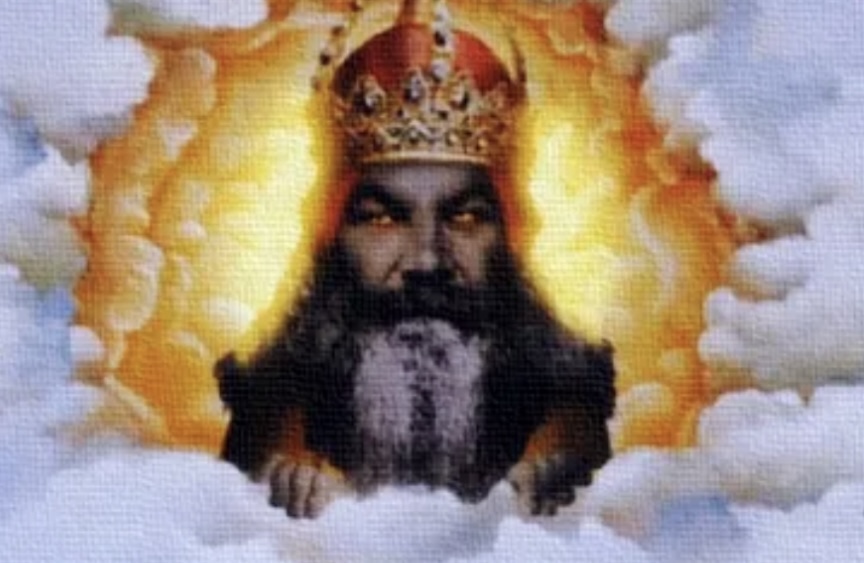
Then you’d hear the most common view. I feel like there’s something. Just a feeling, you know. Oh, naturally, I don’t mean a Jehovah in the clouds with a beard. Ha, ha, ha, that’s silly! But, like, a force. An energy.
Meanwhile, the woman at the end of the table who says nothing is a practicing Catholic.
But what is the difference?
What is the practical difference between the idea of a super-intelligent cosmic being and God?
If I give you some scientific-sounding reasons why we’re probably, in fact very likely, living in a computer simulation, you will at least indulge me. The moon is just code running on a super computer. Why not?
Yet if you’re standing with me on the edge of the Grand Canyon and I say, “Didn’t God make a magnificent world!” you’ll say, “Ugh, why do you have to spoil the moment with religious nonsense?”
What’s the difference?
If I tell you that flying Pegasus unicorns were once real, you’ll look at me like I’m crazy.
But if I tell you about a fossil of a “horse-like” creature with a single twisted horn and back protrusions that suggest some ability to glide for short distances above prehistoric valleys … you say, “Wow, fascinating.”
You might dispute this hypocrisy by saying there’s a big difference between a horse-shaped dinosaur with wings and a magical horse that flies and farts rainbows.
I suppose.
But then I tell you that the paleontologists detect a certain chemical residue in the fossil suggesting that our horse-a-saurus had iridescent qualities. It likely trailed a magnificent rainbow as it sailed over brachiosaurus munching leaves below in the Jurassic swamp.
Well, then I’m sort of telling you that Pegasus unicorns are real. Or were.
There’s a scientific explanation for anything.
As soon as I tell you that I have a machine that detects disembodied neuron charges, we have an explanation for ghosts.
As soon as I tell you that gold, when piled in small, discreet coin-shapes, has certain properties that trigger light refraction in water droplets, it makes perfect sense that the rainbow “ends” in doubloon-filled cookware watched over by short-statured Irish men who have adopted a shaman-like role in their communities.
Nevertheless, a horse-a-saurus is not a Pegasus unicorn, even if our paleontologist tells us that the creature looked exactly like the picture in your childhood fairy tale book … including the big, blinking eyes with long lashes.
If I discovered, in a remote mountain range, a reptile the size of a submarine with giant wings and flammable methane breath (due to the combination of a strange diet and unusual gastric juices) it would not be a dragon.
Unicorns and dragons are magical creatures.
They are not made of atoms. They are made of magic dust.
Which, of course, is really to say that unicorns and dragons are creatures of the imagination.
They exist only in your head.
The instant you describe a dragon or fairy as though it is outside of your head, you’re just talking about some terrestrial entity that by a strange and even miraculous coincidence resembles a purely imaginary being.
As soon as you start talking about bone density in fairies and calculating the wing size necessary for them to flit about, you’re not talking about fairies but a hypothetical species of animal.
The same with God.
As soon as you start describing some universe-sized intelligence and speculate about how its thoughts reside in a quantum network that stretches across trillions of light years, you’re still talking about a creature. A rather large creature, but a creature nonetheless. You’re not talking about God.
So when I ask everyone at the dinner party “Do you believe in God?” it’s like I’m asking “Do you believe in dragons?” I’m not asking “Do you believe in the possible existence of large flame-emitting reptiles?” Rather I’m asking if they believe in a different kind of being that dwells in a different kind of world.
“Do you believe in God” is not asking “Do you believe that an unimaginably powerful being might exist somewhere out there?” It means “Do you believe in a magical being?”
But on a stupidly obvious level … how do you tell the difference?
Imagine you’re out walking your dog in the park one morning. Suddenly a bearded hippie appears in a bright light floating high above an oak tree. How would you know whether this was the living, risen Christ manifesting Himself beyond time and space or the avatar chosen by the cosmic geek running our computer simulation?
If you were Moses out tending your sheep and a shrub ignited and began speaking to you, how would you know whether it was YAHWEH the creator of reality from the eternal realm or … well, would Moses be able to even conceive of energy beings traveling through space?
It makes more sense to look at it from the alien’s point of view. I’m flying through space as an invisible wave of intelligent energy. I detect little sparks of consciousness on a tiny rock circling a small star.
“Hey,” I say to another mega being sailing through the solar system with me. “I’m gonna try to communicate with that shepherd.”
“Ummm …” my friend replies. “You do realize that he doesn’t even know he’s on something called a planet, right?”
“Huh. Wow.”
My companion says, “His little brain will have to tell itself a thousand strange and fabulous stories to try to understand the softest caress from your cosmic wing.”
Of course, modern science doesn’t treat the appearance of spirituality in humans as the result of any transcendental influence, as the product of contact with a higher being or another reality.
And it shouldn’t.
If I tell a legitimate psychotherapist that I was abducted by a UFO, she has a medical duty to treat this idea as the product of my imagination. If she spent all her time calling the Air Force to discover information about the aliens instead of treating my delusion, I could sue her for malpractice, if I ever regained my sanity.
And scientists are obligated to treat God as the product of our collective imagination, our collective delusion, as something other than a superior power.
From a scientific view, with some different twists and turns in our evolution, humans could have just never developed this weird brain activity called “spirituality.” You can imagine flying to some other planet and finding intelligent beings who have no idea what you mean when you talk about God or spirits or magic. How would you explain it to them?
“There is an invisible world.”
“Invisible? Then how do you know it exists?”
“Well, when God created …”
“What is God?”
“Um … God created everything. Reality.”
“A person created reality?
“Not really a person … um … a being.”
It would be like trying to explain red to someone who was born blind.
I think that the cosmopolitan guests at our dinner part would generally think that, like our distant ancestors crawling out of the ocean and making ever longer visits on dry land, humanity is crawling out of an ocean of superstition.
Our spirituality, most of us think, is a last vestige of a primitive state of mind.
In the same way that each new generation of primates spent more time on its feet, each new generation of humans is spending less time its knees.
No hell below us. Above us only sky.
But what if, on the contrary, we have it backwards? What if spirituality is a beginning? What if on the incomprehensible scale of evolution, where it takes a million years to go from a hairy ape to a hairless one, what if spirituality is the twitch of a step forward? What if spirituality is the beach on which we jerk around on our fins in the sun for a minute before galumphing back to the waves?
There is an H.G. Wells story in which a climbing guide slips off a high precipice into the chasm between two shear, towering peaks. Deep snow eases his descent. He finds himself in an isolated valley where he discovers a village. From a ledge above the village’s outer wall, he shouts and waves, but the men he encounters look in all directions for the source of the strange noise.
They are blind. Everyone in the village is blind.
The man, Nunez, recalls the legend of the lost village. Long, long ago, an avalanche trapped the people in this valley, and an epidemic took away their sight.
For fourteen generations these people had been blind and cut off from all the seeing world; the names for all the things of sight had faded and changed; the story of the outer world had faded and changed to a child’s story; and they had ceased to concern themselves with anything beyond the rocky slopes above their circling wall.
Nunez thinks of the old saying “In the land of the blind, the one-eyed man is king,” but he quickly discovers that sight gives him no real advantage.
Everything, you see, had been made to fit their needs … all their methods and procedures arose naturally from their special needs. Their senses had become marvelously acute; they could hear the very beating of his heart. Intonation had long replaced expression with them, and touches gesture, and their work with hoe and spade and fork was as free and confident as garden work can be.
In fact, Nunez’s ability to see mostly makes him seem like an idiot.
The men take him to the elders who are in a pitch black meeting room. A blind world presumably needs no windows. Nunez steps on someone and tumbles onto others, so immediately the whole village believes that he is defective.
Imagine taking someone to your community town hall and the first thing he does is flail around on the attendees.
The world for the villagers ends a short distance up the surrounding hills, and they believe the sky is a stone ceiling arching above “about ten times the height of a man.” All of Nunez’s talk of “seeing” and the clouds and a vast world beyond the valley just make him sound like a lunatic.
What if the ability to see began to return very gradually to the valley? Maybe a random child can sense light. Maybe vague shapes. She wouldn’t know she was seeing. She’s been born into a world where sight does not exist. There are no references to vision.
If you were in this situation, you’d experience the sensory information from your eyes as purely psychological phenomena, as something strange happening in your head. Seeing would be a mystical feeling.
And sometimes magical, even prescient. You can feel that something is about to happen and shoot out your hand to catch a falling cup. How did you know that was going to happen? You push someone out of the way of a falling brick. Incredible! How did you know to do this? Just a feeling.
You wouldn’t have the language to describe the stimuli from your eyes, so you’d use poetry … metaphors and paradoxes mostly of a sonic nature. A flash of red when a cardinal flew past would be an “unheard chirp” or a “silent beep.”
You might tell people that rain comes from another realm, that a great song sends it down to our plane of existence, when you are actually seeing rain clouds in the sky.
As more people in the valley were born with functioning eyes, a kind of mythology or religion would form in response to this soundless sound that you heard with your soul rather than your ears. The whole visual field would be one great song from which the sensory world emerged.
There would be magic stories where a guru urged his disciple to “use the Song” in order to master some difficult exercise like shooting an arrow at a target.
Acting upon the things you “heard” from the silent realm would be proof of your faith in the reality of the unheard music.
Let me drop any coyness about my analogy. I’m explicitly saying that maybe what we call the spiritual is data from a new sense organ. We are “seeing” without knowing what seeing really is. Maybe spirituality is perception.
And all the surreal, irrational, contradictory batshit produced by religion for thousands of years has just been awkward groping in the darkness, awkward groping in the unknown … an awkward reaction to “hearing” what we “see” without any idea what “seeing” really is.
And BECAUSE it’s all such batshit … often leading to bloody crusades, to suicide bombings on buses full of women and children, to unspeakable torment inflicted on people who feel the wrong kind of love … because religion has caused such crazy and impractical behavior, most of our advanced thinkers have been leading us away from believing in a spiritual reality.
Wells says in his story:
Blind men of genius had arisen among [the people in the valley] and questioned the shreds of belief and tradition they had brought with them from their seeing days, and dismissed all these things as idle fantasies, and replaced them with new and saner explanations.
This is hilarious. Some blind philosophers, sitting between tall mountains beyond which is a big, wide world full of crowded cities, are telling their fellow citizens that stories about how they are sitting between tall mountains beyond which there is a big, wide world are childish fairy tales. “Any belief otherwise is madness,” they say, as the unseen moon glides across the star-filled sky.
Meanwhile, in another part of the valley, some friends are having a dinner party on a charming patio under a tree swaying in the late summer breeze.
As she opens another jug of wine, Lena asks, “Do any of you believe in The Song?”
“Ugh!” Juan answers. “Give me a break! Not a single soul has produced the tiniest shred of evidence for the existence of The Song.”
“Well, sure,” says Rosa. “But who really knows? And that’s just the thing. If you don’t know, then what does it matter?”
The leaves in the tree above them have already turned a brilliant yellow.
Roberto chimes in: “Personally, I feel … well … I mean obviously I don’t buy any of that ancient nonsense about how our ancestors wandered into the world from some other world. Just, you know, out of nowhere.”
“I should think not!” Juan interrupts.
“Or …” continues Roberto, “that you could go up and up and up and never reach the top. Ha, ha, ha! Nonsense! But I often have a warm feeling that there is … just … something more.”
“Fine and dandy!” says Juan. “Nothing wrong with fuzzy feelings, but taking any of these fantasies seriously I think is genuinely unhealthy.”
A gust of wind shakes the tree.
He pounds the table with a fist: “It’s a form of insanity!”
Blown from their stems, yellow leaves swirl away above Juan.
“This is the only world. And it’s enough.”
An inexplicable and inexpressible bliss suddenly overcomes the quiet woman at the end of the table. The morning sun has inched into a gap between the mountains. It sets the trees climbing the distant slopes ablaze. The stone face of the mountain shines like a plate. She can see it all but experiences it only as causeless joy that floods her.
Without knowing it, she sees the sun painting her friends orange.
They only feel the warmth.
Wells explains that in the Valley of the Blind, people sleep in “the warm” — what the rest of the world, the existence of which these people deny, calls day. They live and work in “the cool,” what we call night. They have had this lovely dinner party in the last hours of the cool.
Someone yawns.
“Well, it’s certainly past my bedtime!”
Everyone agrees.
After drawing out their good nights, the friends embrace and stumble out into the blazing sun. The quiet woman feels a strange impulse to hold her flat hand perpendicular to her forehead.
“How did it get so late? I’ll be a wreck tomorrow!”
And they all make their weary ways to beds in the darkness of windowless rooms.
 Kenny Nowell